
The Mind's Search for Meaning
- Sam Rothrock
- Jun 5
- 4 min read

A coherent worldview is important because it contributes to human survival and flourishing. Having an accurate picture of reality helps with decision making, identity-level stability, and persistence in the face of hardship. For the individual, the structure of reality is key to doing hard things when motivation fails.
Humans cannot respond to suffering without interpreting it. A model of reality functions as an interpretive structure that assigns meaning, responsibility, possibility, and value to events. Psychological resilience is not merely emotional regulation; it depends on the quality of the interpretive framework through which experience is processed.
When we lack a methodically designed worldview, negative events feel chaotic and overwhelming. We react to difficulty, then treat discomfort itself as the problem. Rather than learning from the experience, we avoid, suppress, or distract ourselves from it. What could have become wisdom becomes fear. Fear makes our worldview fragment further. Future challenges seem even more threatening, and the cycle repeats.
In the mind's search for meaning, we will consider whether worldview building is merely a cultural activity or the ultimate expression of our humanity.
A Universal Human Impulse
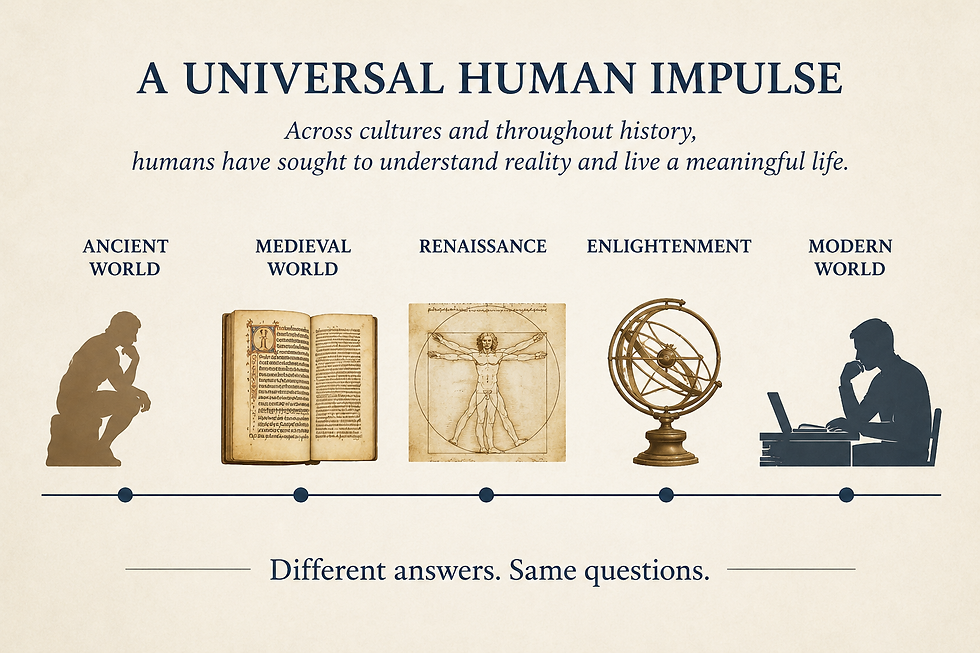
Worldviews span all cultures and time periods. All known civilizations have produced philosophical thought, even when writing material was difficult to come by and survival was a struggle. We find religious texts, musings about meaning, and universal concepts. People have always asked questions about reality, good and evil, suffering, and how to live a meaningful life.
They came to different conclusions, but the question
s and the search were the same. Across these traditions, thinkers converged on one conclusion: life should be organized around what produces meaning. Those conclusions force people to consider the ethical implications, their relationships to roles and responsibilities, and the reality of injustice.
The universality of worldview building does not prove a genetic mechanism. However, when a behavior emerges repeatedly across all walks of life, it raises the possibility that our cognitive architecture naturally generates this kind of thinking.
Psychological Mechanisms
Psychology has devoted considerable attention to the impact a coherent worldview has on the human psyche. Freud’s model of the psyche assumed that people constantly negotiate competing demands from reality, desire, and moral obligation. His work reflects a broader observation that humans construct interpretive frameworks to understand themselves and the world.
More modern approaches with existential psychology focus on the therapeutic value inherent in the search for meaning. They highlight that everyone faces death, freedom, responsibility, isolation, and meaninglessness. Therapy involves developing answers to those core questions. Victor Frankl noted that meaning can, and should, be found among unavoidable, terrible suffering.
Neurological Architecture
The brain is, and always has been, in the business of constructing models of reality. It does not just build arguments using rationalization and reason, it actively determines what is real, useful, and valuable.
Think about everything involved in taking a bite of food:

The eyes see something. They send a splotchy picture of what might be food to the occipital lobe.
The brain fills in the gaps of what the eyes "see" using continuity and experience.
The brain also gets other sensory inputs like smells and environmental context. That information reinforces the conclusion that, "Yes, this is food."
The brain coordinates necessary motor skills to reach for, pick up, and bring food to the mouth. That involves manipulating fingers, coordinating arm movement, and estimating distance from plate to mouth.
Of course, neither the brain nor eyes can see the mouth. So, there are complex processes activated there too.
The mouth bites, chews, tastes, and swallows the food, all while avoiding the worst outcome: choking.
This is a minimalist description of what the brain is coordinating. The impressive thing is that these things do not require conscious effort.
The brain itself manages decisions concerning reality, value, and meaning, and it is doing it without conscious input. There is a huge gap between our perception and the real world. What we see, interact with, and experience every day is constructed.
The brain is working on partial information and constantly updating its interpretation templates. It is great at detecting errors and changes, but it places a lot of trust in existing models of the world. It only has access to muted, indirect sensory inputs and past perceptions to construct a worldview. It determines what is real by taking information and constructing a template, then corroborating it with the past. It assigns criteria for determining what is real and makes value judgments about ambiguous or conflicting information.
Why Worldview Coherence is Important
It is not that anyone must accept a particular metaphysical system. The issue is whether a person can live psychologically well while refusing to think seriously about their worldview at all. People inevitably interpret experience through some framework. The quality and coherence of that framework therefore become psychologically consequential.
We need a way to interpret suffering, obligation, desire, fear, death, community, and the good life. Without that, the mind builds interpretations, but does so in fragments. It borrows from the culture when convenient and rejects the same information when it is inopportune.
That is the problem. Not that people have chosen the wrong meaning structure, but that many have never chosen one at all. People inherit slogans, preferences, reactions, therapeutic vocabulary, political instincts, and childhood residues. Then they try to build a stable identity out of the pile.
That can work in calm conditions, but not in hardship. Since suffering is not an exception, but one of life’s basic conditions, a coherent framework is not optional. It gives a person the capacity to move through life without being broken apart by it. Meaning-making isn't a habit or a skill — it's a function of being human. The mind does it automatically, constantly, whether we direct it or not. So the real question isn't whether the mind is building a worldview. It's whether you are the one building it.
Download the Free PDF. No email, no info. No strings. Please share.
-J. S. Rothrock

Comments