.png)
Hate Mindfulness. It's not rest.
- Sam Rothrock
- Jan 19
- 9 min read

When “calm down” becomes another form of avoidance—and how to use mindfulness for real decisions
Most people don’t hate mindfulness because it’s stupid.
They hate mindfulness because it works, but it's not rest.

Not the way it’s advertised, but the way it actually functions in the human mind. Mindfulness gets packaged as a wellness product—a soft landing, a nervous system lullaby, a clean way to “reset.” People are overwhelmed, stressed, running hot for months at a time, and someone offers the modern solution: sit still, breathe, focus, notice. As if attention is the same thing as rest.
And sometimes it feels like it is. The first few sessions might feel lighter. The breathing slows. The mind quiets down. The shoulders drop. That’s the seductive part. Because then the brain makes the obvious conclusion: mindfulness is for feeling better.
Then the next session happens. Or the fifth. Or the day you try mindfulness after a hard conversation, a stressful workweek, or a choice you’ve been avoiding. Suddenly it’s not calm. It’s louder. It’s more sensation, more agitation, more thoughts, more discomfort. It feels like something is wrong. It feels like failure.
But nothing is wrong. The mechanism is doing exactly what it’s supposed to do.
Mindfulness is not rest. It’s exposure.
What This Actually Is
This is not a motivational speech, and it isn’t a spiritual pitch. This is a practical explanation of why mindfulness often backfires for high-performing adults—and what it’s actually for when you use it correctly. The point isn’t to make mindfulness look impressive. The point is to make it usable.
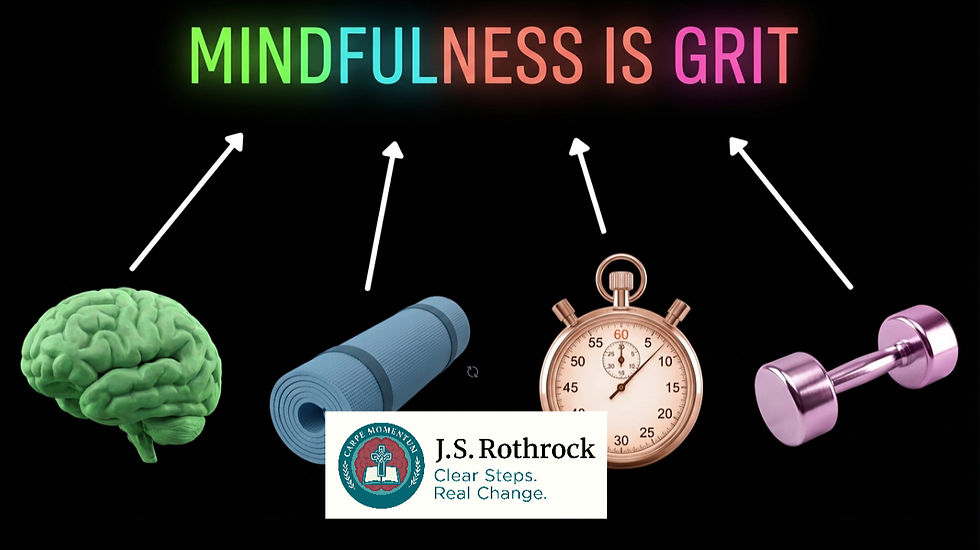
Why Mindfulness Gets Mis-sold
Rest lowers pressure. Rest refills the tank. Rest turns the volume down.
Mindfulness does the opposite. It's not rest.
Mindfulness turns the volume up. It increases signal. It reduces the background noise of distraction so the mind can’t hide behind movement. It asks for attention “on purpose,” which sounds gentle until you realize most of modern life is structured to help you not pay attention on purpose. Many people hate mindfulness for this reason.
People stay okay because they stay occupied. Scrolling, planning, working, talking, snacking, fixing, improving, optimizing. Even self-improvement can be a distraction if it keeps you away from what you don’t want to feel.
Mindfulness interrupts that. It removes the usual escape routes. When that happens, whatever you’ve been carrying—quietly, underneath the noise—becomes louder.
That doesn’t mean mindfulness created the discomfort. It means mindfulness revealed it.
When people say, “Mindfulness made me worse,” what they often mean is: “Mindfulness stopped my numbing.”
Why It Can Feel Worse at First

A lot of people try mindfulness and immediately report the same things:
More body sensations. More scary thoughts. More anxiety. More restlessness.
Then they conclude: “This isn’t for me.” They hate mindfulness.
That reaction is understandable. But it confuses discomfort with danger.
The simplest explanation is this: your distractions stopped working. The numbing wore off. The avoidance strategies got interrupted. And now you feel what you were already carrying.
Mindfulness asks you to do something most adults are not trained to do: It's not rest.
Stay with a feeling without trying to fix it. Stay with a thought without chasing it.
Stay with discomfort without running away.
That is not restful. It’s active. It uses energy. It demands presence.
If mindfulness is treated like a sleeping pill for emotions—something that knocks you out internally—you will hate it. Because that isn’t what it does.
Mindfulness isn’t mainly about feeling better. It’s about seeing more clearly.
That alone is enough to make it offensive to the part of you that wants relief without contact.
Pressure Without Direction
There’s a specific kind of person who struggles with mindfulness in a predictable way.
You can execute for other people all day. You can handle responsibility, solve problems, manage tasks, and keep functioning even when it’s a lot. You can be the reliable one. You can be the calm one. You can be the one who holds the line.
But when it’s time to choose your own life, something changes.
Not because you aren’t smart. Not because you lack insight. Not because you need more research.
The freeze happens because choosing creates a different kind of pressure: identity pressure.
A decision isn’t just a decision when it forces self-definition. It forces you to become the kind of person who did that thing. It forces you to live inside the consequences. It forces you to lose options. It forces you to be seen.
So the mind does what it does best: it delays.
And the delay gets a sophisticated name. It gets called “uncertainty.” It gets called “needing clarity.” It gets called “overthinking.”
But a lot of “I’m confused” is really: “I don’t want to pay what this choice will cost.”
Mindfulness threatens that entire strategy, because it reduces the space where self-doubt can masquerade as prudence.
It brings you back into contact with what is already true.
The Overthinking Loop: Information as a Cover
Overthinking is often treated like a cognitive problem. People assume the fix is better thinking, clearer thinking, more rational thinking.
But overthinking is rarely a thinking problem.
It’s a behavior. A strategy. It's not rest.
Overthinking is what happens when the mind keeps generating analysis to avoid committing to a direction that will change your life. It lets you stay active without choosing. It lets you keep moving while staying the same.
There’s a reason high performers love it. It looks responsible. It feels intelligent. It creates the illusion of progress. It keeps you busy.
Busy is the perfect hiding place. Busy is what you do when you’re afraid of self-definition. That's why you likely hate mindfulness.
The mind builds a professional-looking fence around avoidance. It calls it planning.
This is why mindfulness can feel like an insult. It stops the motion. It pulls your hands off the steering wheel you use to keep avoiding the truth. It forces you to be with the exact moment you’d rather talk around.
Why “Calm First” Can Be Another Avoidance Strategy
A common approach to decision-making is: calm down first, then choose.

That sounds mature. It sounds wise. It sounds regulated.
But it can easily become another delay tactic.
Because if you only allow yourself to choose when you feel calm and certain, you’ve just built a rule that protects avoidance forever. You will almost never feel completely calm in the moments that matter. You will rarely feel entirely sure about choices that involve risk, identity, or cost.
The real skill isn’t becoming sure. The real skill is choosing while you feel unsure.
Mindfulness is training for that exact capability.
It isn’t a mood-management technique. It’s an honesty technique.
It teaches you to stay present in the discomfort that shows up when you approach a real decision. It teaches you to notice the body reaction. The mental story. The urge to delay. The urge to outsource the decision to other people.
And then—here’s the key—it teaches you not to escape.
That’s the training.
Mindfulness Isn’t Meditation: It’s Real-Life Attention
Meditation is one way to practice mindfulness. It’s not the only way, and for many people it’s not even the best entry point.
Mindfulness works best when it’s tied to real situations where you tend to disappear from yourself.
It works best when you use it where your avoidance patterns actually show up:
Hard decisions. Anxiety spikes. Relationship tension.
This is where mindfulness stops being abstract and becomes functional.
Mindfulness for Hard Decisions: Choosing While Uncertain
Most people want clarity to arrive before they commit.
But clarity often doesn’t arrive as a feeling. It arrives as a cost.
You learn what you care about when you see what you’re willing to lose. You learn what matters when the body reacts to the truth of saying yes or no.
Hate Mindfulness. It's not rest.
So here’s the shift:
Instead of trying to calm down before deciding, train the ability to decide while uncomfortable.
If you’re stuck on a boundary, a job move, or a hard conversation, mindfulness looks like this:
Picture each choice. Notice what your body does. Notice what your mind says. Notice the urge to delay, ask everyone, or talk yourself out of it. Stay with the moment.
The outcome isn’t instant certainty. The outcome is self-contact.
That’s what overthinking avoids: self-contact.

The Spreadsheet Problem: When Smart Becomes Stuck
Smart people get trapped in a predictable pattern.
A job offer appears: more money, more freedom, better role. The kind of thing that should be easy to evaluate. So the brain does what smart brains do: it makes a spreadsheet.
Then it upgrades the spreadsheet. Then it adds weighted categories. Then it asks seven people. Then it reads ten articles. Then it tries to find the perfect rationale.
And still nothing moves.
Because the problem isn’t information.
The problem is what “yes” would mean.
Mindfulness cuts through this by skipping the intellectual negotiation and going straight to the data that can’t be faked: the body.
Picture saying yes. Don’t solve it. Just notice what happens.
Tight chest. Stomach drop. A sense of pressure.
Then the truth shows up—not always as a sentence, but as a felt meaning:
It’s not fear of the job. It’s fear of what “yes” makes you responsible for. It’s fear of losing the right to hide.
Overthinking protects you from that. Mindfulness removes the protection.
Mindfulness for Anxiety: Without Trying to Control It
A lot of people attempt mindfulness and immediately try to use it to calm themselves down.
That’s not mindfulness. That’s controlling.

Mindfulness doesn’t start with “how do I make this go away?” It starts with “what is actually happening?”
Notice the feeling. Notice the urge to run. Notice the story the brain tells.
Then don’t jump in to rescue yourself.
Over time, this builds a specific kind of strength: the ability to feel discomfort and still stay present.
That’s not rest. It’s capacity. And it's why you hate mindfulness.
And capacity matters more than comfort if you’re trying to live a life that requires choices, boundaries, and honesty.
Mindfulness in Relationships: Staying in the Room
You can practice mindfulness while talking to another person. Especially during conflict.
This is one of the most useful and least romantic versions of mindfulness, because it happens inside the moments where people most often abandon themselves.
During tension, notice:
The tight chest. The hot face. The fast heart. The urge to argue, defend, shut down, or disappear. The harsh thoughts that pop up.
Then do the hardest part: stay present anyway.
This is training for adulthood. It’s staying in the room when the nervous system wants to flee. It’s learning you can be activated and still choose your behavior.
Mindfulness isn’t here to make relationships feel smoother. It’s here to make you more honest inside them.
Why Mindfulness Fails When It’s Treated Like Rest
Mindfulness does the same thing in every form: it removes the escape routes.
It removes distraction.It removes excuses.It removes the fantasy that clarity will feel good.
That’s why it fails when it’s marketed as rest.
Rest is passive. Mindfulness is active. Rest gives you energy. Mindfulness uses energy. Rest turns the volume down. Mindfulness turns it up.
Both matter. They’re just not the same tool.
When you treat mindfulness like rest, you’ll interpret its real effect as failure. You’ll feel worse and assume you did it wrong. You’ll quit early, or water it down until it becomes a calm music break.
But mindfulness wasn’t designed to sedate you.
It was designed to wake you up.
When Mindfulness Is Too Much, Too Fast

Mindfulness isn’t always a good fit for every person at every time. Some people hate mindfulness.
Sometimes the volume turns up so fast it feels flooding. Sometimes attention is too intense when the internal system is already overloaded.
That doesn’t mean you’re failing.
It means dosage matters. Pace matters. The right amount at the right speed matters.
One of the worst things modern wellness culture does is assume one technique fits everyone equally. That’s not how humans work. A tool can be useful and still be misused.
Mindfulness is powerful. That means it needs precision, not pressure.
The Punchline: Clarity, Not Calm
If you want a simple summary:
Mindfulness is not mainly for calm. Mindfulness is for clarity.
Sometimes calm comes later. Sometimes it doesn’t.
But clarity always asks something from you.
Clarity means you can’t pretend you don’t know. It means you can’t hide behind confusion. It means you can’t keep calling avoidance “thoughtfulness.” It means you’re responsible for the next move.
That’s why the Permissionless Achiever hesitates. Not because of laziness. Because clarity threatens the comfort of not choosing.
Mindfulness forces self-authorization. It's not rest.
And self-authorization feels like pressure because it is. It’s the pressure of being the one who decides.
Scope & Responsibility
Hate Mindfulness. It's not rest. This is education, not diagnosis or treatment; you’re responsible for your choices. This content does not create a clinical relationship, and it can’t replace support from a licensed professional when that’s needed. The point is to give you a clearer way to understand what mindfulness is doing so you can use it deliberately instead of treating discomfort as failure.

If you want the written framework, the OverThink Profiler is available free by email here: Clear thinking, practical recommendations, and an quick update on what we’re up to. Here's how to keep in touch!
Free Monthly Newsletter: https://subscribepage.io/jsrothrock

Comments